
What Is Organic Skin Care? Organic vs. Natural Labels
Decode natural, organic, USDA and COSMOS labels. Compare the percentage categories and distinguish an ingredient certificate from a finished-product claim.
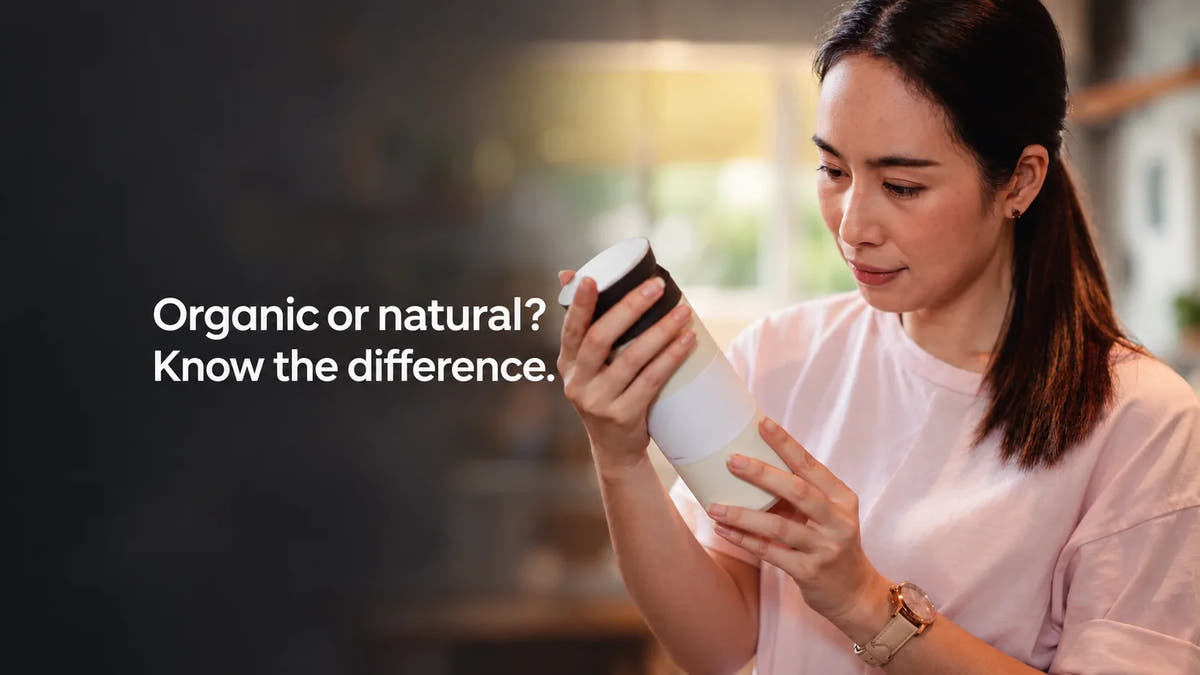
Two bottles sit beside each other. One says natural. The other says organic. Both have a leaf on the label. Are they telling you the same thing?
No—the words can describe different things, and the details matter. Read the exact claim, identify the standard behind it and check whether it refers to one ingredient or the finished product. A front label is the beginning of that check.
Natural, organic and certified: three questions to separate
Natural: what does the seller mean by it? In the United States, FDA has not established a regulatory definition of natural for cosmetic labeling. Other markets and voluntary standards may use different criteria. [2]
Organic: which production or sourcing standard is being referenced? In the US, USDA’s National Organic Program addresses organic agricultural ingredients and qualifying products. It is separate from FDA’s cosmetic safety requirements. [1]
Certified: who checked what? Look for the certifier, the named scheme and the product or ingredient covered. Do not turn a supplier’s ingredient certificate into a claim that every product sold by the brand has the same certification.
A useful example: the USDA categories
The categories below summarize the USDA system for eligible certified products. They are not universal definitions for every cosmetic sold worldwide. Percentages exclude water and salt, and the detailed rules include requirements beyond the percentage alone. [3]
| Label category | Organic content and seal |
|---|---|
| 100 percent organic | 100% of counted ingredients. Eligible certified products may display the USDA seal. |
| Organic | At least 95%; restrictions apply to the remainder. Eligible certified products may display the seal. |
| Made with organic… | At least 70%, with further conditions. No USDA organic seal. |
| Below 70% | Qualifying ingredients can be identified as organic in the ingredient statement. No USDA organic seal. |
Water and salt are excluded from these percentage calculations. This is a summary of the US system, not a global labeling rule or a certification decision. [3]
A percentage therefore needs context. Ask whether it describes the whole formula, a group of ingredients or a calculation that leaves out particular components. Two percentages calculated differently are not a fair comparison.
COSMOS uses its own product signatures
COSMOS ORGANIC and COSMOS NATURAL are distinct signatures shown with a responsible certifier’s mark. ORGANIC requires the standard’s minimum organic content; NATURAL does not require those same minimum percentages. Labels can state organic content for the whole product and may also show a calculation excluding water and minerals. [4]
Keep the scheme attached to the claim when comparing products. Applying a USDA percentage threshold to a COSMOS label without its calculation rules can lead to the wrong conclusion. A named natural certification and an unqualified marketing word are also different kinds of information.
Read a claim in three passes
- Read the sentence exactly. “Contains organic aloe” identifies an ingredient claim. It does not tell you, on its own, the certification status of the complete cream.
- Find the scope. Look for the product name, formula or ingredient covered, the certifier and the standard. Check that the record actually matches the item you are considering.
- Ask the unanswered question. If the product page gives a percentage without an explanation, ask what is included in the calculation and how it was verified.
A useful message is: “Which certification scheme covers this exact product, and can you share the current product listing or certificate?” A specific question is easier to answer than asking whether the whole brand is clean.
One more COSMOS distinction: COSMOS CERTIFIED and COSMOS APPROVED are raw-material signatures. COSMOS ORGANIC and COSMOS NATURAL identify qualifying finished products. A raw-material record is not the finished product’s certificate. [4]
What these labels do not decide for your skin
Ingredient origin does not determine safety. Botanical ingredients can cause reactions, and an organic claim does not establish that a formula suits every skin type. [1]
You still need the complete ingredient list, intended use and directions. Whether a cream feels comfortable, removes makeup or improves a particular concern is a separate question from how its agricultural ingredients were produced.
Likewise, check vegan, animal-testing, packaging and environmental claims individually. Do not silently add them to the meaning of organic because the packaging suggests an overall lifestyle.
Your next label check
Before buying, write down the exact claim you care about and the evidence you found. If all you have is a brand name and a green illustration, there is still a question to ask. If the documentation is clear, move on to whether the formula and routine suit you.
For help evaluating benefits rather than terminology, use the related guide below. You can value organic sourcing while asking precise questions about it.
Sources and further reading
- FDA: “Organic” cosmetics
- FDA: Small businesses and homemade cosmetics, section 7
- USDA: Labeling organic products
- COSMOS: Organic and natural product certification
Cover photograph: Sam Lion / Pexels. Composition adapted with AI assistance. Illustrative image; no diagnosis or treatment result is depicted.
Written by the Dirran Organic editorial team. Reviewed November 2, 2026. General skin-care education; individual conditions may need professional assessment.

Ingredients and Serums
Organic Skincare: Benefits, Limits, and How to Choose
Understand the real benefits and limits of organic skincare. Check sourcing, skin-performance and packaging claims separately before deciding what is worth buying.

Ingredients and Serums
Organic and Conventional Skincare: How to Compare Formulas
Compare organic and conventional skincare fairly: formula, evidence, directions and a worked price example—not assumptions about ingredient origin.

Ingredients and Serums
Plant-Based Skin Care Ingredients: Roles and Limits
Learn what aloe, jojoba, shea and green tea names reveal—and what they do not—with a practical guide to reading the complete skincare formula.
Leave a comment+