
Organic and Conventional Skincare: How to Compare Formulas
Compare organic and conventional skincare fairly: formula, evidence, directions and a worked price example—not assumptions about ingredient origin.
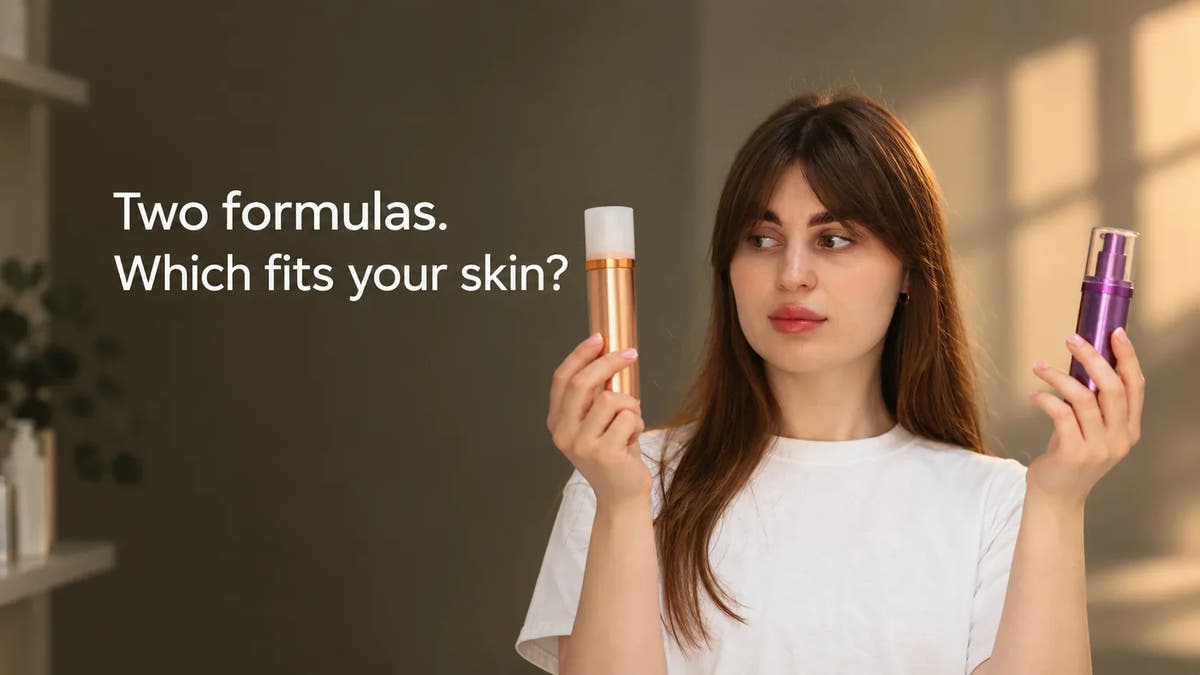
One bottle emphasizes organic plants. Another highlights a laboratory-developed ingredient. Both promise smoother-looking skin. Which information actually helps you choose?
Start by comparing the same job, then the complete formulas. Organic sourcing can be a meaningful preference. It does not replace the questions of how a product is used, what it contains and whether it fits your routine.
First, understand what you are comparing
Organic usually refers to a defined production or certification claim. Conventional is a broad shopping description, not a single formula type or a safety rating. Neither tells you whether the product is a cleanser, moisturizer or targeted treatment.
All formulas contain chemical substances, including plant oils and water. FDA explains that ingredient origin does not determine safety: a plant-derived material can also cause harm or allergy. An organic claim therefore cannot settle which of two products your skin will tolerate. [1]
Our label guide below explains certification wording. Here, the task is to compare two actual products without turning their ingredient origins into competing teams.
Put both products through the same four checks
Compare like with like
Write an answer for each bottle. Leave missing information marked as unknown.
01
Same purpose
Compare a rinse-off cleanser with a rinse-off cleanser, or two moisturizers intended for the same area.
02
Complete formula
Look beyond the featured ingredient. Check the full list against any sensitivities you already know about.
03
Usable directions
Compare application, frequency, warnings and how each fits with products you already use.
04
Relevant evidence
Ask for documentation that supports the exact sourcing or performance claim that matters to you.
A label reading “with vitamin C” does not make a cleanser interchangeable with a serum. One is rinsed away; the other may be intended to remain on the skin. Comparing them only by their shared headline ingredient misses the decision you need to make.
Read ingredients by their role, not their familiarity
A formulation can combine botanical ingredients, cleansing agents, texture ingredients and a preservation system. A familiar plant name is not a complete explanation of its role, and an unfamiliar name is not a reason on its own to reject it.
Dirran’s Vitamin C Cleanser record offers a concrete example. It lists aloe and plant oils alongside sodium ascorbyl phosphate, several cleansing agents and phenoxyethanol. Its instructions describe washing and rinsing. The useful comparison is with another cleanser’s full formula and directions, rather than with a generic idea of what natural products contain.
If you already have a diagnosed ingredient allergy, use the names your clinician has identified. A general preference for plants, or a long “free from” list, may not answer that specific question.
Preservation is part of product design
Preservatives can help prevent harmful bacteria and mold from growing in cosmetics. FDA’s explanation of parabens illustrates this role; it is not a recommendation to choose every formula containing that particular ingredient family. [3]
The finished product still needs an appropriate safety assessment. FDA describes using ingredient data, similar-formula information and additional testing where needed. The ingredients, packaging and conditions of use all matter. [2]
“Preservative-free” is therefore a question to investigate, not an automatic safety advantage. Ask how the product is protected during normal use. Follow its storage instructions, keep containers clean and closed, and do not keep using a cosmetic whose smell or colour has changed. [5]
Ask evidence to answer one claim at a time
A certificate about an agricultural ingredient can answer a sourcing question. A study of a finished moisturizer can address a particular measured result. Neither automatically answers the other question.
For a performance claim, ask which product was studied, how the result was measured and for how long. A study of an ingredient by itself is a starting point for understanding it; it does not establish that every bottle containing it produces the same result.
Keep your own priorities explicit. You might prefer verified organic sourcing, a texture that sits comfortably under makeup or a formula that avoids a known trigger. These are different reasons to choose, and you can evaluate them separately.
Compare cost without losing sight of use
| Example bottle | Price per mL |
|---|---|
| A: $24 for 30 mL | $24 ÷ 30 = $0.80 |
| B: $35 for 50 mL | $35 ÷ 50 = $0.70 |
These are fictional prices, not current Dirran prices. Bottle B costs less per mL but more at checkout. Neither calculation tells you cost per use: amounts, frequency and unused product can change the answer.
Make the decision in this order: suitable formula, manageable directions, then price. A larger bottle is poor value if it irritates your skin or duplicates a step you already own.
Make the first trial easy to interpret
Before wider use, the AAD recommends a small-area trial for seven to ten days, following the product’s normal leave-on or rinse-off use. Stop if a reaction occurs. Home testing does not replace professional allergy testing. [4]
Then introduce one new product and keep the rest of your routine familiar. Judge it against its intended job: cleansing, moisturizing or the particular goal you chose it for.
You do not need to declare one entire category the winner. You need enough information to choose the next product well.
Sources and further reading
- FDA: “Organic” cosmetics
- FDA: Product testing of cosmetics
- FDA: Parabens and the role of preservatives
- AAD: How to test skin-care products
- FDA: Using cosmetics safely
Cover photograph: Anna Keibalo / Pexels. Composition adapted with AI assistance. Illustrative image; no diagnosis or treatment result is depicted.
Written by the Dirran Organic editorial team. Reviewed November 2, 2026. General skin-care education; individual conditions may need professional assessment.

Ingredients and Serums
What Is Organic Skin Care? Organic vs. Natural Labels
Decode natural, organic, USDA and COSMOS labels. Compare the percentage categories and distinguish an ingredient certificate from a finished-product claim.

Ingredients and Serums
Organic Skincare: Benefits, Limits, and How to Choose
Understand the real benefits and limits of organic skincare. Check sourcing, skin-performance and packaging claims separately before deciding what is worth buying.

Ingredients and Serums
Choosing an Organic Serum: Ingredients, Goals, and Skin Tolerance
Choose an organic serum for one clear goal. Compare the full formula, plan a careful introduction and decide whether it earns a place in your...
Leave a comment+