
Retinol for Fine Lines: How to Start and What to Expect
Start retinol with realistic expectations, a clear evening routine and an active-product check. Understand Dirran’s documented 2.5% blend and 0.25% retinol.
Updated November 2, 2026.
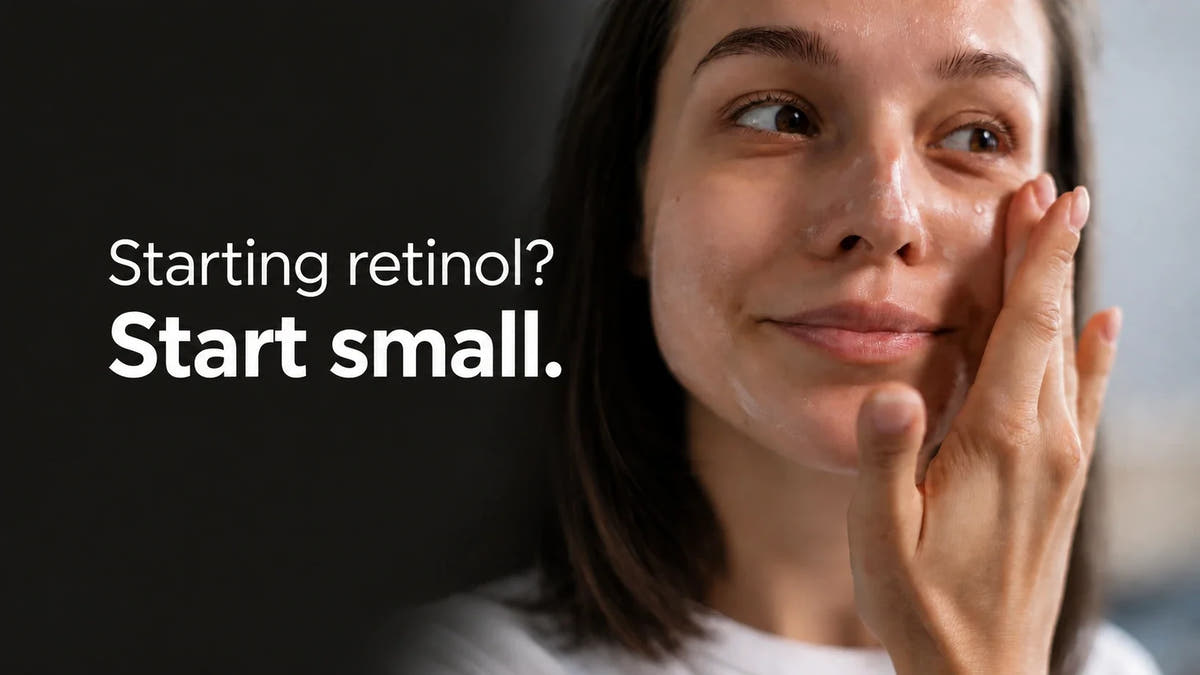
You want softer-looking lines, but the bottle’s percentage tells only part of the story. The useful starting point is a formula you can introduce comfortably—and a way to judge what changes.
Retinol is a vitamin A derivative that may soften the appearance of fine lines over time. Start with one suitable product, a simple evening routine, and realistic expectations. Sunscreen and moisturizer are the foundation; retinol is an optional addition. [1] [2]
Before you start
Check these three situations before adding retinol:
- Pregnant or trying to conceive? Avoid retinoids, including retinol. If you are breastfeeding, ask your clinician which skin care products are suitable. [5] [6]
- Skin already dry, inflamed, or irritated? Ask a dermatologist before starting. Our skin barrier guide can help you review your current routine. [2]
- Already using a prescribed treatment? Check with your prescriber before adding retinol so that the advice fits your existing treatment.
Your evening routine, step by step
For a retinol serum used before moisturizer, the sequence is straightforward. Check your chosen formula's directions for the amount and application areas.
On a retinol evening


On evenings without retinol: keep your familiar cleansing and moisturizing steps.
Every morning: use broad-spectrum SPF 30 or higher, alongside shade and protective clothing.
Start with a frequency you can tolerate. UNC Health's dermatologist guidance suggests every other night or two nights a week, increasing gradually. That is general guidance, not a schedule for every formula. Sensitive skin may need a slower introduction. Increasing frequency does not mean increasing the amount. [6]
Test a new product on a small area before broader use, without exceeding its directions. A small-area test can reveal a reaction, but cannot guarantee that repeated facial use will be comfortable. [7]
How long should results take?
Think in weeks and months. The American Academy of Dermatology notes that many anti-aging products need at least six weeks, and sometimes three months, to show effects. That is a general timeframe, not a deadline or guarantee for a particular retinol product. Moisturizer can make some fine lines look less noticeable sooner. [8]
Make your own progress easier to assess:
- Choose one goal. For example, the appearance of fine lines in a particular area.
- Keep comparable photos. Use the same lighting, distance, and facial expression, without filters.
- Record changes to your routine. Note when you started, how often you applied it, and any discomfort. This helps separate a change in product from a change in frequency.
If results disappoint, review your goal and routine with a dermatologist before moving to a stronger formula. A higher percentage alone cannot tell you which product will work better for you. [6] [8]
What if your skin becomes uncomfortable?
Dryness, redness, or flaking can occur. Peeling is not a target or a measure of success. Stop a cosmetic product that burns or stings; if a dermatologist prescribed the treatment, contact them for advice about adjusting it. Irritation can also trigger dark marks, particularly in darker skin tones. [2] [8]
If you develop an itchy or swollen rash, gently wash the product off and stop using it. Seek medical advice for a severe or persistent reaction. Keep the packaging and a note of what else you used that evening to help identify a possible cause. [7]
What does the research actually show?
Retinol, retinal, and prescription tretinoin are different retinoids. Results for one ingredient or formula do not automatically apply to another. See our retinol and retinal comparison for more on those distinctions. [2]
A 2021 review of nine controlled trials found inconsistent results and substantial weaknesses in research on over-the-counter vitamin A cosmetics for facial aging. [4] More recent facial research adds useful detail: a 2024 randomized trial compared 0.5% retinol with another active ingredient, oleyl adapalenate, for 12 weeks. Of 48 participants, 39 completed all visits. Image analysis showed reduced wrinkle severity from the starting measurements in both groups, with a larger reduction in the comparison group. [3]
The newer trial had no inactive comparison group, mainly included lighter skin types, and was funded by the supplier of the comparison ingredient. It therefore cannot establish how much improvement came from retinol rather than the cream base, or predict results across all skin types. Neither study tested a Dirran formula. [3] [4]
Photography: Alena Darmel and RDNE Stock project / Pexels. Cover composition adapted with AI assistance.
Sources
- American Academy of Dermatology: How to select anti-aging skin care products.
- American Academy of Dermatology: Retinoid or retinol?
- Nguyen N, et al. A prospective, double-blinded, randomized head-to-head clinical trial of topical adapinoid (oleyl adapalenate) versus retinol. Skin Health and Disease. 2024;4(6):e469.
- Spierings NMK. Evidence for the efficacy of over-the-counter vitamin A cosmetic products in the improvement of facial skin aging: a systematic review. Journal of Clinical and Aesthetic Dermatology. 2021;14(9):33–40.
- American Academy of Dermatology: Dermatologist-approved pregnancy skin care.
- UNC Health: Frequently asked questions about retinoids. June 17, 2026.
- American Academy of Dermatology: How to test skin care products.
- American Academy of Dermatology: Wrinkle remedies.
- Product composition: manufacturer’s product index, June 2025, Advanced Retinol Serum — 2.5% Formulation and Advanced Retinol Moisturizer entries. The serum entry specifies 2.5% Centersome®RL Liposomal Complex. Product documentation held by Dirran Organic.
- Declared retinol content: Dirran Organic cosmetic-notification formulation records (2025): 2.5% Retinol Serum (NOT250902100K) and 2.5% Retinol Moisturizer (NOT250902112K). Both list retinol at 0.25%. These are declared formulation values, not independent batch-test results.

Ingredients and Serums
Retinol vs. Retinal: Differences and How to Choose
Compare retinol and retinal without misleading strength claims. Understand conversion steps, study limits and Dirran’s documented blend and retinol percentages.

Skincare Basics
Eight Practical Steps for Skin Care as You Age
Eight practical ways to care for skin as it ages, with sun protection, comfortable daily care, realistic retinol expectations and clear ways to review results.

Hydration and Barrier
Skin Barrier Basics: Signs of Irritation and Gentle Care
Understand the skin barrier with a clear diagram, review irritation triggers and simplify your routine without mistaking every rash for dryness.
Leave a comment+